Pokechill Faster Guide: Speed Up Leveling Without Wasting Resources
A practical progression guide for players who want faster Pokechill leveling, better overnight idle results, and cleaner upgrade choices without turning the game into a risky resource sink.

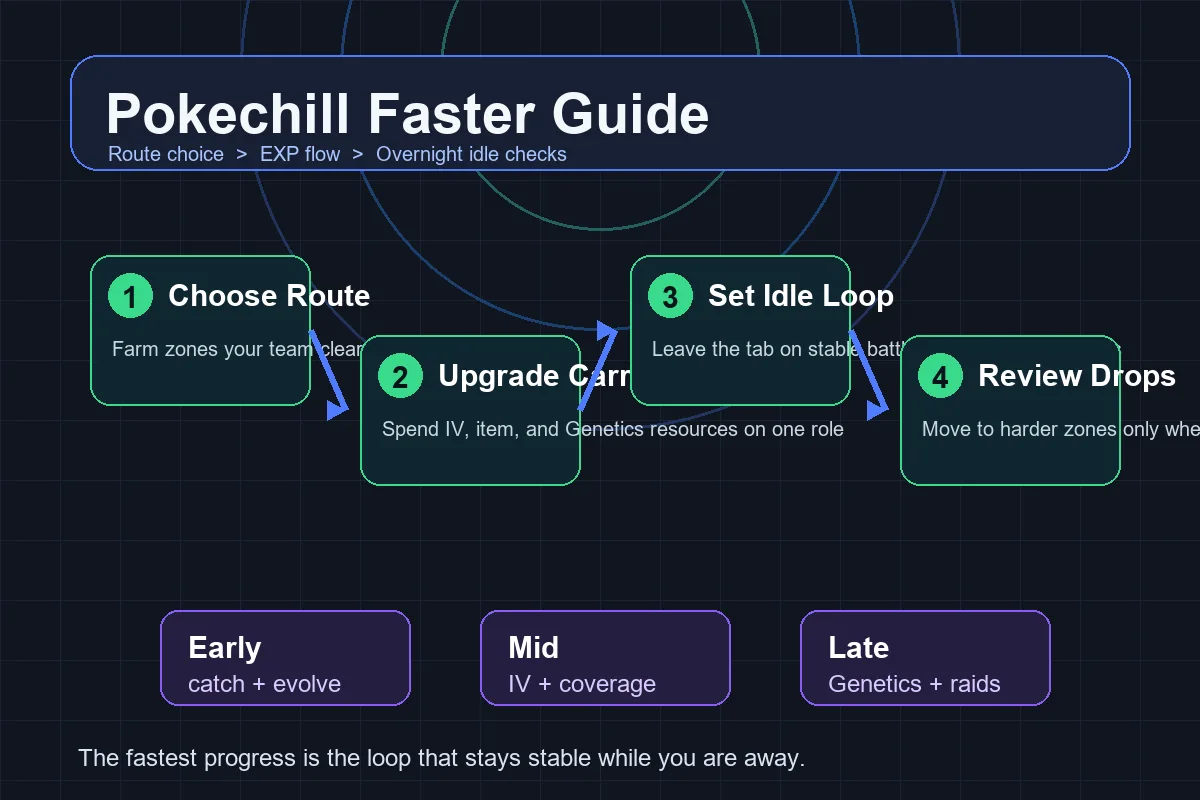
The Fastest Safe Loop in Pokechill
If you are searching for how to speed up Pokechill, start with one rule: clear speed only matters when the loop survives. A route that gives slightly more experience but makes your team faint, stall, or burn through healing time will often produce worse real progress than a lower route your team clears cleanly for hours.
Think of progression as a loop instead of a single battle. The loop includes encounter speed, damage consistency, survival, evolution timing, item drops, and how often you check the game. The best route is usually the highest route where your main attacker still wins reliably and your support Pokemon do not collapse against common counters.
Use this guide alongside the Pokechill Guide, Evolution Chart, and Tier List. The guide explains broad mechanics, the evolution chart keeps level planning accurate, and the tier list helps you decide which Pokemon deserve long-term resources.
Stable route
Choose the strongest zone your team clears repeatedly, not the newest zone you can barely survive.
Focused carry
Invest in one reliable damage dealer before spreading upgrades across every interesting catch.
Coverage partner
Add a second Pokemon that handles the matchups that stop your carry.
Review loop
After each evolution or major upgrade, retest the route instead of assuming the old farm remains best.
Best Place to Level Up in Pokechill
The best place to level up in Pokechill changes as your account grows. Early players need routes that keep catches and basic evolution moving. Mid-game players need routes where their strongest line can clear while a second Pokemon gains value. Late-game players should compare reward quality, Genetics plans, and whether a harder route actually improves hourly progress.
A simple test works better than guessing: run the candidate route for five to ten minutes, note fainting, battle speed, drops, and level gains, then compare it with the previous safe route. If the harder route wins only when you actively babysit it, it is probably not your best idle route yet.
| Stage | Recommended Route Choice | What to Check |
|---|---|---|
| Early game | Use routes your starter or first strong catch clears without frequent healing. | Catch variety, first evolutions, and whether one Pokemon is becoming a dependable carry. |
| Mid game | Farm the highest stable route where your carry wins and your coverage partner gains useful levels. | Type counters, evolution levels, IV quality, and whether upgrades reduce battle time. |
| Late game | Compare harder routes by rewards per hour, not only by enemy level. | Genetics value, raid preparation, shiny or IV goals, and whether overnight runs stay stable. |
How to Overnight Pokechill Safely
Overnight progress is where many Pokechill players lose efficiency. The goal is not to leave the game on the hardest possible battle. The goal is to leave it on a route that keeps producing while you are away. Before a long idle session, do a short test while you are still watching the screen.
If the team fails after three minutes, it will not magically become stable after three hours. Drop one route lower, adjust your lead Pokemon, or spend a targeted upgrade. A reliable overnight route should keep the same basic battle rhythm without requiring constant manual correction.
- Test for 10 minutes first. Watch for fainting, slow matchups, and whether the battle loop remains smooth.
- Use a stable lead. Put the Pokemon with the best repeatable matchup in front, not the one you only want to level quickly.
- Avoid fresh experiments overnight. New builds, weak shinies, and untested Genetics changes should be checked during active play first.
- Review in the morning. Compare levels, drops, and bottlenecks before deciding whether to push to a harder route.
Upgrade Priorities for Faster Progress
Fast progress usually comes from fewer, better upgrades. When every Pokemon gets a small piece of every resource, none of them becomes strong enough to unlock a better farm. Pick a carry, support it with coverage, then spend on the next bottleneck only after you know what is slowing the loop.
Use IVs, evolution timing, and team role together. A high-tier Pokemon with poor IVs may still be useful temporarily, but it should not always become your permanent resource target. A lower-ranked Pokemon with excellent IVs and the right matchup can be the correct bridge while you search for a better long-term host.
| Priority | Spend On | Delay Until Later |
|---|---|---|
| 1 | One main attacker that improves your current farming route. | Cosmetic or collector upgrades that do not change clear speed. |
| 2 | Evolution levels and items that unlock a real role upgrade. | Evolving weak candidates before comparing IVs or team need. |
| 3 | Coverage Pokemon that solve the matchup that stops your carry. | Training several duplicate attackers that lose to the same counter. |
| 4 | Genetics only when the host and sample plan is clear. | Random transfers without a target build. |
Progress rule
Spend only when the upgrade changes the loop: faster clears, fewer fainted battles, better overnight stability, or a route that was previously too hard.
Mistakes That Make Pokechill Feel Slower
1. Pushing routes too early
A harder route is only faster when it stays stable. If your team wins slowly or faints often, move down and build strength first.
2. Ignoring evolution timing
Some power jumps are locked behind evolution. Check the Pokechill Evolution Chart before spending resources on a form that will soon change role.
3. Training only favorites
Favorites are fun, but progress needs coverage. Use the Tier List to compare long-term value, then keep one flexible slot for matchups.
4. Using Genetics without a plan
Genetics can improve a team, but random transfers slow you down. Decide whether the Pokemon is the host, the sample, or just a temporary bridge before spending.
5. Treating overnight play as a gamble
A short test before sleep prevents long sessions with poor rewards. Overnight progress should be boring, stable, and easy to review.
Sources and Version Notes
This guide is based on current Pokechill site resources, including the Pokechill Guide, Wiki, Evolution Chart, Tier List, Shiny Guide, and Charizard Build. It focuses on progression decisions rather than a single fixed route because balance and route rewards can change.
For current mechanics, compare your in-game tooltips with public reference material such as the PokeChill Game Guide. If a later patch changes route rewards, Genetics costs, or evolution behavior, the in-game interface should take priority over any older article.
Frequently Asked Questions
Last updated: May 29, 2026